With the release of the LM301B LED chip in mid-2017, Samsung has thrown the world of lighting pretty much into turmoil. With an efficiency of up to 220 lumens per watt, the package remains the leader in commercially available LEDs. Of course, efficient LEDs are especially interesting for grow lamps. That’s why we take a closer look at the chip. Here you can find the data sheet.
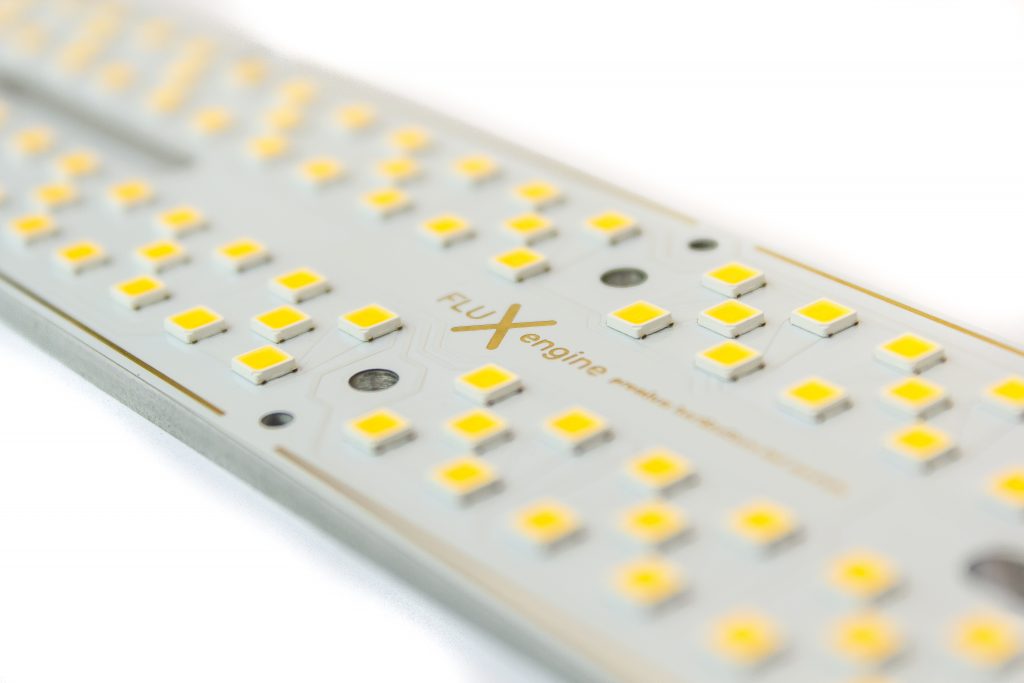
Internally, the LM301B is the heir to the previously sought-after LM561C. Both are mid-power LEDs, an area in which Samsung has been able to gain a lead in recent years. The secret of this success is the so-called flip chip technology in combination with advanced phosphor coating. Let’s explain it briefly!
Light-emitting diodes consist in their core of a “chip” which, depending on the material, begins to emit monochromatic light at a certain voltage. These chips are normally built into a package and bonded to the contacts of the package with gold wires. However, this entails the disadvantage that the thin gold wires are very sensitive and can break at low stress. In addition, reflections in the case cause efficiency losses at various points.
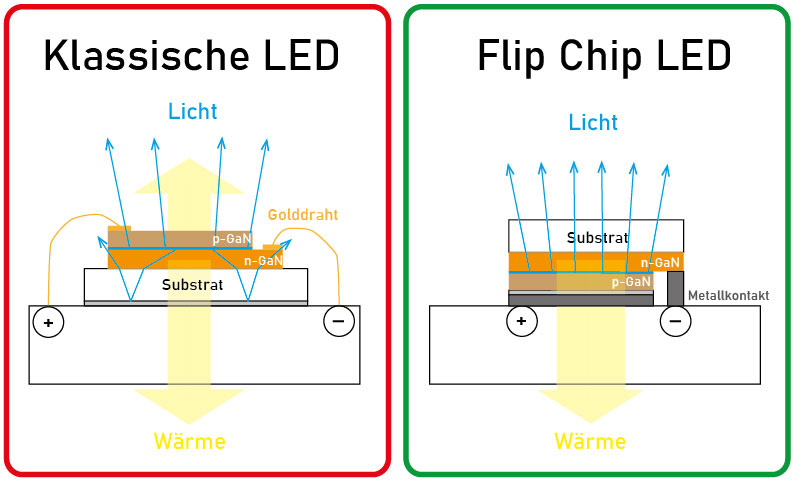
In flip chip technology, this problem is simply bypassed by turning the chip over and binding the P and N conductors of the material directly to the metal contacts in the package. The result is a more durable and efficient LED. In addition, heat dissipation is significantly improved through the metal contacts. This sounds simple, but this technology requires advanced manufacturing techniques that have been optimized on the LM301B to set a new record for luminous efficacy.
Originally, light-emitting diodes, were only possible in the colours red and green. Other colors or even a full spectrum were not feasible. Only with the development of the gallium nitride semiconductors at the beginning of the 90s was it possible to realize blue LEDs. This wavelength contains photons that transport a lot of energy. If these energy-charged light particles are exposed to certain luminescent materials, they are excited to emit light of lower energy (= higher wavelength, i.e. green, yellow, red…). This is called luminescence. A layer of phosphors on top of the LED chip makes it possible to produce a full spectrum of light from blue light, which appears white to our eyes.
In luminescence, the quality of the materials is particularly important as to how efficiently the blue light is converted. It also determines the spectrum in which light is emitted. The same blue LED can achieve different colour rendering values and colour temperatures with different coatings. With the LM301B, Samsung offers a wide range of 70, 80 and 90 CRI, as well as different values between 2700K and 6500K colour temperature. For the FLUXengine , however, we prefer the colour temperature of 3500K. This is the ideal spectrum for the entire plant cycle. The colour rendering index of 80 offers the best compromise between efficiency and spectral quality.
We all know that lumen values - as impressive as 223 lm/W may sound - are not Plant lighting not a real benchmark are. But Samsung also published PPF values for some product lines in May 2018. We can now say with certainty that the LM301B outperforms all white LEDs here too - with a whopping 2.92 µmol/J at a current of 65 mA. If the LEDs are energised at a lower current, you can easily exceed 3.0 µmol/J.
A new variant of the LM301 series, the LM301H, was announced at the end of 2018. "H" for "Horticulture" - that sounds very promising. According to Samsung reports, the efficiency has increased by 0.18 µmol/J compared to the LM301B. It is specified as 3.10 µmol/J (at reference values).
We were able to get to the Comparison of the first generation FLUXengine with the FLUXengine v2 we found an almost 5% higher efficiency, but we attribute this to the improved binning.
We only order pre-selected chips with the highest luminous flux, i.e. the SL Bin at 3500K, from Samsung. Have a look at the video how the single SMD components are mounted on the board!
https://www.youtube.com/watch?v=4Di3mb-e-tw&lc=z22wj5igrkqdydqtbacdp43bhorj3eedkyuzkipgfx1w03c010cSamsung has announced a new generation of LM301 LEDs. The new LM301B Evo and LM301H Evo feature improvements in phosphor conversion and reflection in the chip package, resulting in an efficiency increase of a good 5 % (up to 235 lm/W).
The LM301H Evo types are specified with a slightly increased efficiency of 3.17 µmol/J (5000K) or 3.2 µmol/J ("Mint White" spectrum). This corresponds to an improvement of 2 -3 %.

























<![CDATA[
[...] One possible solution to achieve high performance without sacrificing efficiency and illumination are Grow LED Boards. These modules are available in numerous varieties. Most often they are equipped with mid-power LEDs, such as the efficient Samsung LM301B. [...]
]]>