To optimise the VPD, the temperature and relative humidity must be closely monitored and regulated. Here are some tips for making adjustments:
Use measuring devices: Use Hygrometer and thermometer* to precisely monitor the humidity and temperature in your indoor garden.
Ventilation and climate controlEnsure that the ventilation and climate control systems in your grow room are working effectively to regulate temperature and humidity.
Light adjustmentsLight sources increase the temperature, which affects the VPD. A well-planned lighting strategy can help to keep the VPD in the optimum range.
Water managementWater your plants regularly and make sure that the humidity does not get too high.
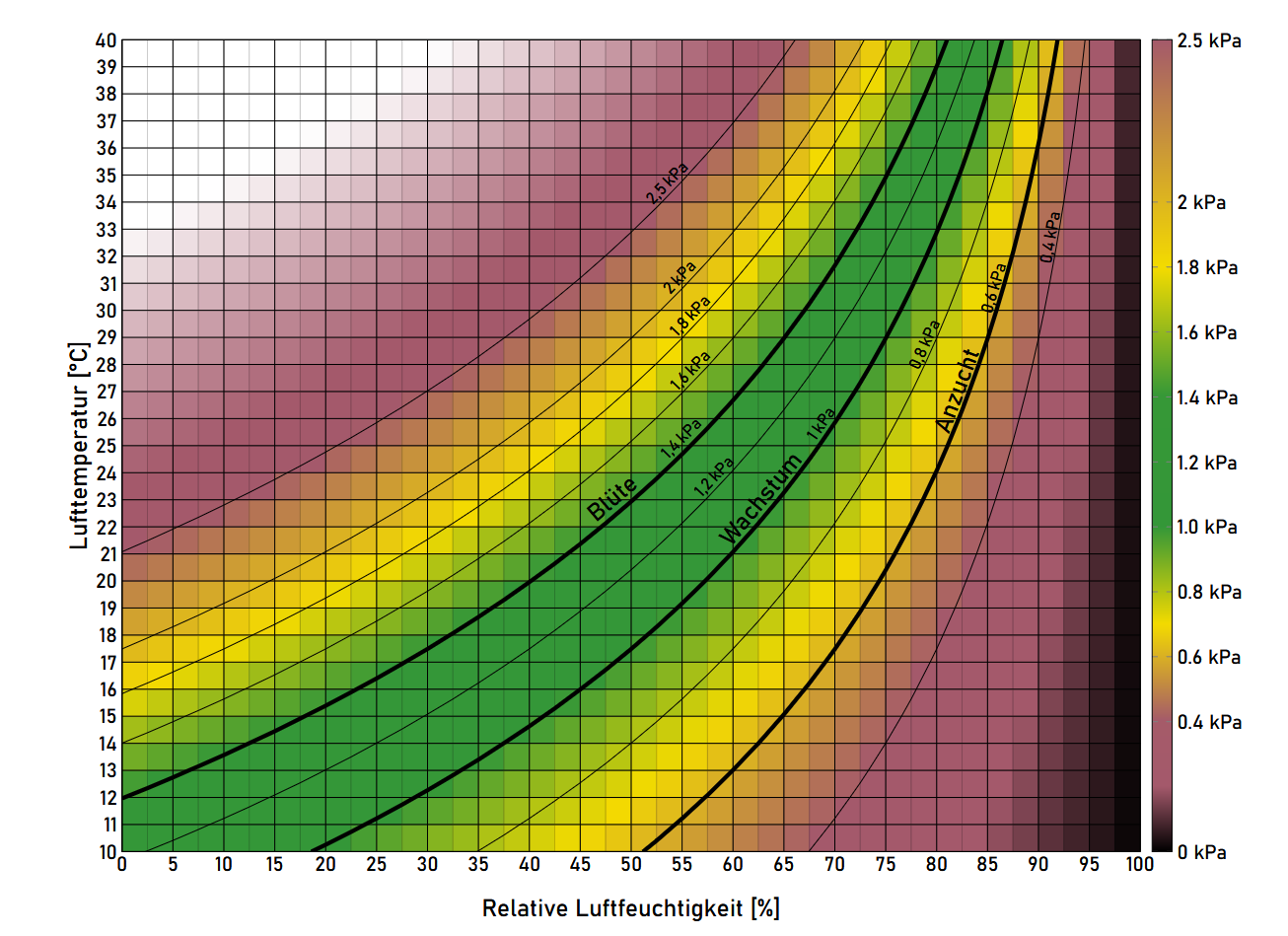
The table helps to check whether the VPD fits!
Optimum areas for growth and flowering:
Green and darker shades of green: show the optimum VPD values depending on the temperature.
Hazardous areas:
Light and dark orange zones: These indicate the values that are too low or too high for growth and flowering.
Why is VPD important in indoor horticulture?
Controlling the VPD is crucial for plant growth, as it directly influences the transpiration (moisture loss) of the plants. An optimal VPD ensures that the plant absorbs and transports water and nutrients efficiently. If the VPD is too low, the plant cannot transpire effectively, which can lead to overwatering and nutrient deficiency. If the VPD is too high, the plant loses too much water, which can lead to stress, weakened cells and slower growth.
Here are some important reasons why VPD should be optimised in indoor horticulture:
Growth and earningsAn optimised VPD supports even transpiration, which is essential for plant health and yield.
Disease preventionIf the VPD is too low, the humidity can increase to such an extent that mould or fungal infestation can occur.
Nutrient intakeVPD influences the plants' water and nutrient uptake. A balanced VPD supports even absorption.
What is the vapour pressure deficit (VPD)?
The vapour pressure deficit is a measure of the difference between the actual moisture in the air and the maximum amount of moisture that the air can hold at a certain temperature. Put simply, it describes how "thirsty" the air is.
The VPD is influenced by two main factors:
Air temperatureWarm air can absorb more moisture than cold air.
Relative humidity (RH)This is the ratio between the current humidity in the air and the maximum possible humidity that the air can hold at the given temperature.
A low VPD value means that the air is almost saturated and can only absorb a small amount of moisture. A high VPD value indicates that the air is relatively dry and could absorb much more moisture.
Welcome to the Crescience blog! Here we regularly cover current topics and provide important insights on the subject of indoor horticulture. Discover our latest articles now. We look forward to your comments!
*) In some of our blog posts we use links that refer to Amazon. These are so-called affiliate links through which the authors of our articles can earn a commission.
Cookies help us to make our site better - and your experience more enjoyable. Some are for statistical or advertising purposes only. You decide what is allowed.
Functional
Always active
Technical storage or access is strictly necessary for the legitimate purpose of enabling the use of a particular service explicitly requested by the subscriber or user or for the sole purpose of carrying out the transmission of a communication over an electronic communications network.
Preferences
The technical storage or access is necessary for the legitimate purpose of storing preferences that have not been requested by the subscriber or user.
Statistics
The technical storage or access, which is solely for statistical purposes.Technical storage or access used solely for anonymous statistical purposes. Without a subpoena, voluntary consent from your Internet service provider, or additional records from third parties, information stored or accessed for this purpose cannot generally be used alone to identify you.
Marketing
Technical storage or access is necessary to create user profiles, to send advertising or to track the user on a website or across multiple websites for similar marketing purposes.


























Does not match the table from Purolyt. Please ask for clarification here.
Link to the table:
[Link removed by moderator]
Thanks for the hint. I forgot to replace the placeholder. Now the table is quite similar I think?