Grow LEDs are typically switched on and off periodically to mimic the daily cycle of the sun. Most indoor gardeners use Mechanical timers. Apart from the fact that these are often of inferior workmanship and can pose a fire risk (experienced this myself!), the setting options are limited. At best, 15-minute intervals can be selected at which the lamp is either switched on completely or switched off. Digital timers partly solve this problem, finer time settings are possible there.

There are various ways to make a Grow LED smart. The simplest of these is probably a Wifi adapter. These usually have an app for the smartphone that can be used to specify the switching times. The critical point here is that user data is usually routed via the servers of the Far Eastern providers. The mass use of these products also makes them worthwhile targets for hackers - many a botnet consisting of such smart home devices, has already been discovered.
Although the Wifi adapter plug allows wireless control via app, it does not yet fulfil the wish of most people who want a smart plant lamp. We were frequently asked for sunrise and sunset simulations. In addition, we know that ambitious growers often rely on sophisticated light recipes in which the spectrum is to be changed during the course of the day.

The classic example is the so-called "sleep light" with Far Red (730 nm). Here, a separate channel with this wavelength is operated for 10-20 minutes after the main light has been switched off. Studies indicate that this leads to an accelerated transformation of the phytochromes, which ultimately allows longer exposure times (e.g. 13 hrs on / 11 hrs off) without damaging the plants.
In the meantime, almost every well-known manufacturer has a controller solution for its own lamps on the market. Prices range from just under €100 to over €2000, whereby the range of functions and quality naturally scale with the price. The number of outputs, the control panel (touch or buttons), display size and many other factors play a role.
Our Grow Controller CresControl, for example, almost completely dispenses with a physical control interface, as any terminal device with a Crescience hub can be used for this purpose at any time. Those who do not want to do without a stationary control panel can use a discarded tablet or smartphone for this purpose.
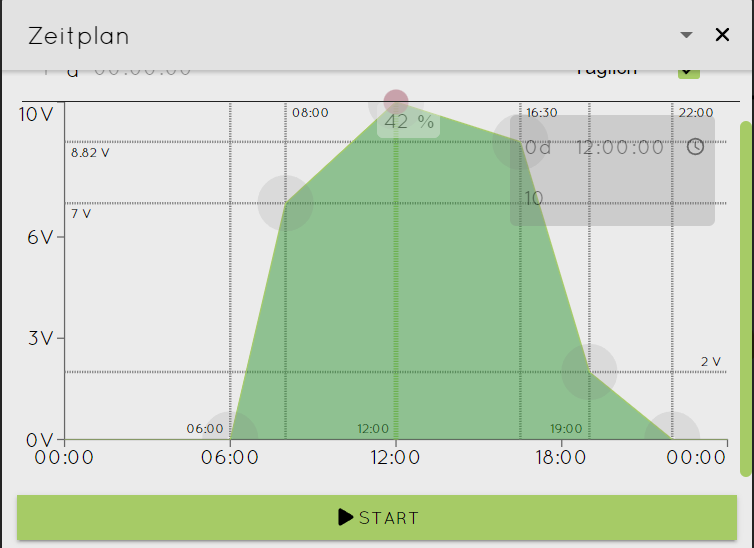
With CresControl, all resources are invested in an open and versatile platform. With the numerous inputs and outputs and the fully customisable app, CresContrl and Crescience Hub leave nothing to be desired. The basic functions for lighting control alone are already very extensive and are being further refined:
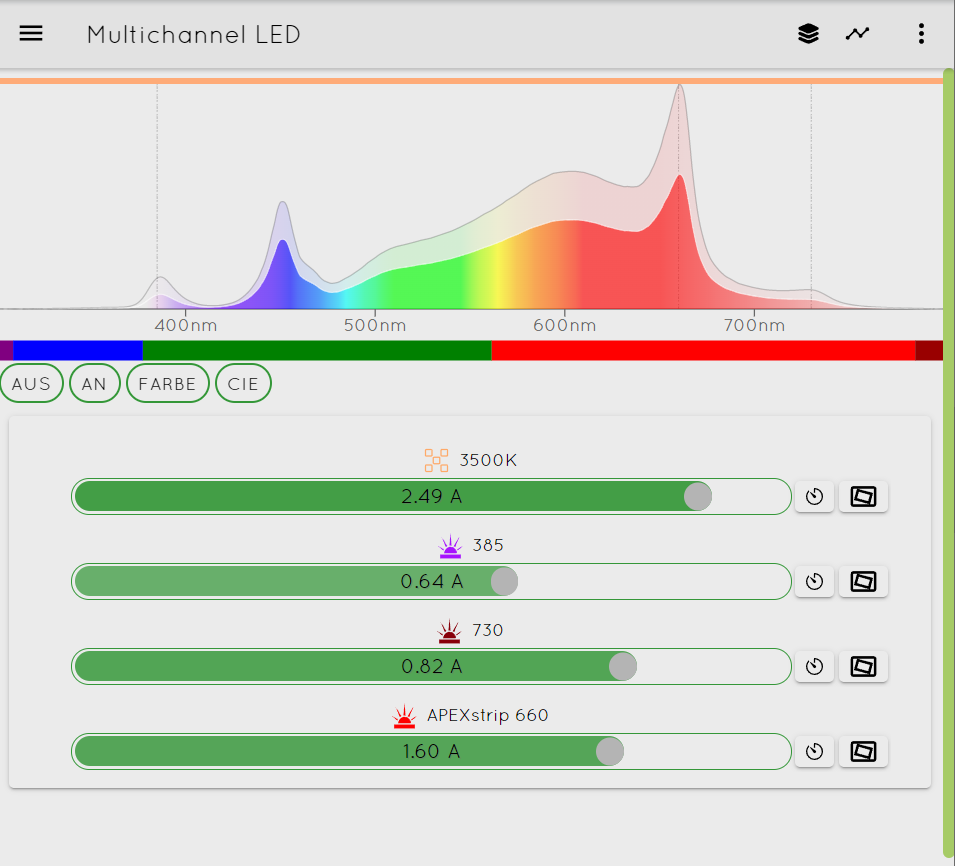
To make a Grow LED smart, you only need to connect the control input to the outputs of CresControl. Normally, the cable has two wires, DIM + and DIM -. Some LEDs have these two wires integrated in an RJ11 or RJ12 network connector. Here you can usually try out without risk which two contacts are occupied with the plus and minus pole.
Once the driver is connected, you can configure the output with schedules and access the lamp at any time via our Crescience Hub app. Crescience Hub ensures a secure user experience with data minimisation, incognito wifi and SSL encryption.
We are happy if you liked the article and share it!