More and more indoor growers are looking into the use of Far-Red (far red, 700-750 nm) in cannabis cultivation. While red and blue have always played the main roles in plant lighting, recent studies show that the "invisible red" can also play a key role. Far-Red not only influences elongation growth, but also photosynthesis efficiency, flower induction and cannabinoid formation. When used correctly, it opens up new opportunities for growers to realise the full potential of their plants - but when used incorrectly, it can lead to undesirable effects.
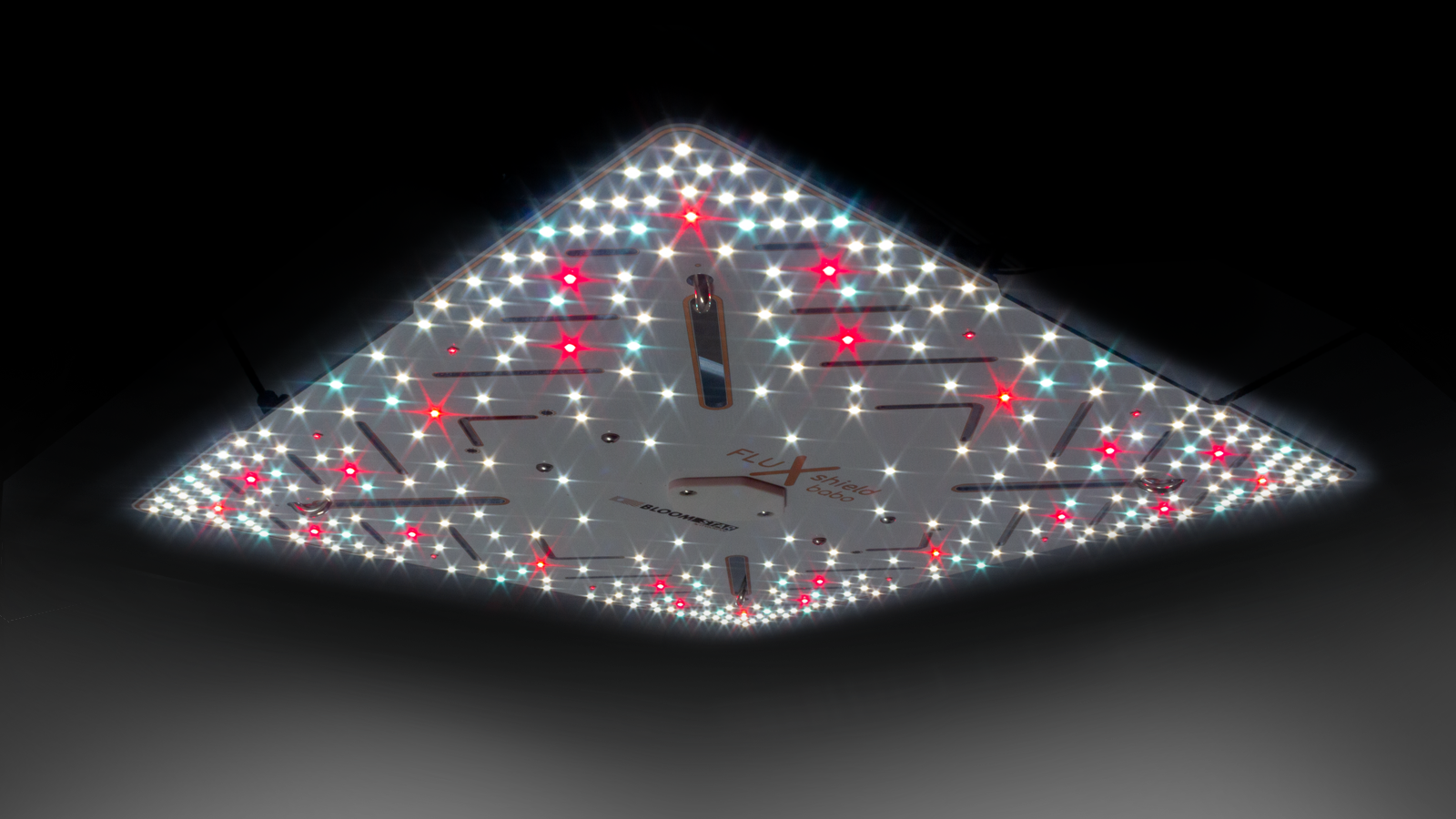
As early as 1957, Robert Emerson stated that the Simultaneous irradiation with red (~660 nm) and far red (~730 nm) increases photosynthetic performance more than either spectrum alone. This so-called Emerson effect is based on the fact that the two photosystems (PSII and PSI) are optimally utilised. For cannabis, this means that Far-Red can improve light utilisation efficiency, provided that sufficient red light is available. Modern LED grow lights such as our FLUXshield Babo 450C specifically use 660 nm deep red in combination with 730 nm far red to imitate this effect.
A short pulse (15-30 minutes, integral ~20,000 µmol/m²) directly after lights-out can accelerate the conversion of the active phytochrome. The plant thus interprets the day as shorter, which increases the Flower induction starts earlier. For varieties with a longer pre-flowering period, this can be a real shortcut.
An EOD colour red signal makes it possible to extend the photoperiod to practically 13/11. This gives the plants 8 % more DLIwithout the need for more powerful lamps or additional light sources. This increase in photosynthesis can increase the yield, whereby the variety is decisive: some react positively, others show delays in flowering.
If far-red is used for 1-2 hours or longer in the evening, more biomass and flower mass can be achieved in some cases. However, there is an increased risk that the plant will "misinterpret" the dark phase, which can delay flowering. This method is therefore rather experimental for practice-orientated growers.
In addition to the end-of-day strategies, the Ratio of red to far red (R:FR) decisive. A low R:FR (lots of far-red) promotes elongation growth and increases flower mass - but can dilute the cannabinoid concentration. A high R:FR (little far-red) leads to more compact plants with sometimes higher levels of active ingredients, but with lower yields. Growers should therefore consciously weigh up whether Quality or quantity has priority.

Far-Red is not a miracle cure, but a Tool for fine tuning. Whether faster pre-flowering through short EOD pulses, more yield through a 13/11 strategy or experimental long-term exposure: the benefits depend heavily on the variety, setup and objective. Used correctly, however, radiation in the 700-750 nm range can optimise photosynthesis, accelerate flowering induction and improve yield performance.
In order to utilise the Emerson effect flexibly and still maintain control over the morphology, we have developed the FLUXshield Babo 450C with two light spectra.
You have full control with our individually customisable Module sets and one Controller control. This allows you to adjust the EOD colour red and intensity depending on the phase and optimise the light regime.
Here are a few more sources to deepen your knowledge of Far-Red:
No. Cannabis grows and flowers even without far-red. Nevertheless, its use can bring specific advantages - such as faster pre-flowering, a higher DLI or denser flower structures. Whether far-red is worthwhile depends on the variety, setup and goals.
For EOD impulses an integral of approx. 20,000 µmol/m² proven. This corresponds to an irradiation period of 15-30 minutes at 20-50 µmol/m²/s. Longer phases with far-red (1-2 h) are experimental and can delay flowering.
Yes, with targeted EOD-FR, it is possible to switch from 12/12 to 13/11 to switch. This increases the daily light integral (DLI) by approx. 8 %without the lamp having to provide more power. Important: Test depending on the variety, as some cultivars react sensitively.
Studies show: More far-red can increase yield but lower cannabinoid concentration. A high red:far-red ratio (R:FR), on the other hand, promotes dense buds and often more potency. Growers must therefore consciously weigh up whether to prioritise quality or quantity.
Not every LED has integrated 730 nm diodes. Modular systems with a separate FR channel are recommended in order to be able to control far red completely independently.